
- Category:
Web Development, AI Solutions
- Technologies:
Astro 5
Tailwind CSS 4
TypeScript
Vercel
Resend
Vercel Blob
Cloudflare Turnstile - Service:
Web Development
AI Visual Production
Local SEO - Client:
Custom Hub Studio — Cambridge, MA
- Website:
- Date:
September 2, 2026
Custom Hub Studio Brand & Order Site
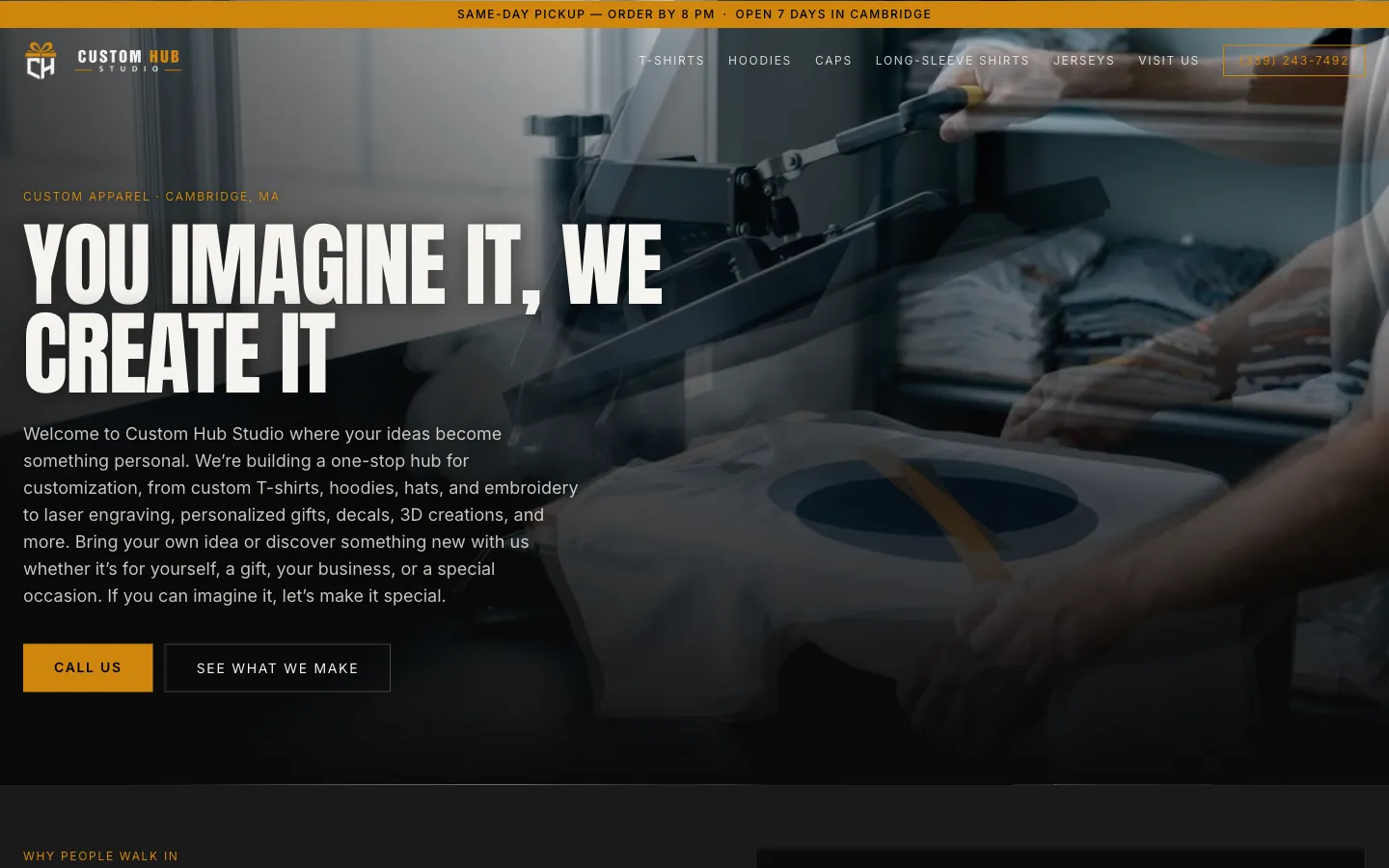
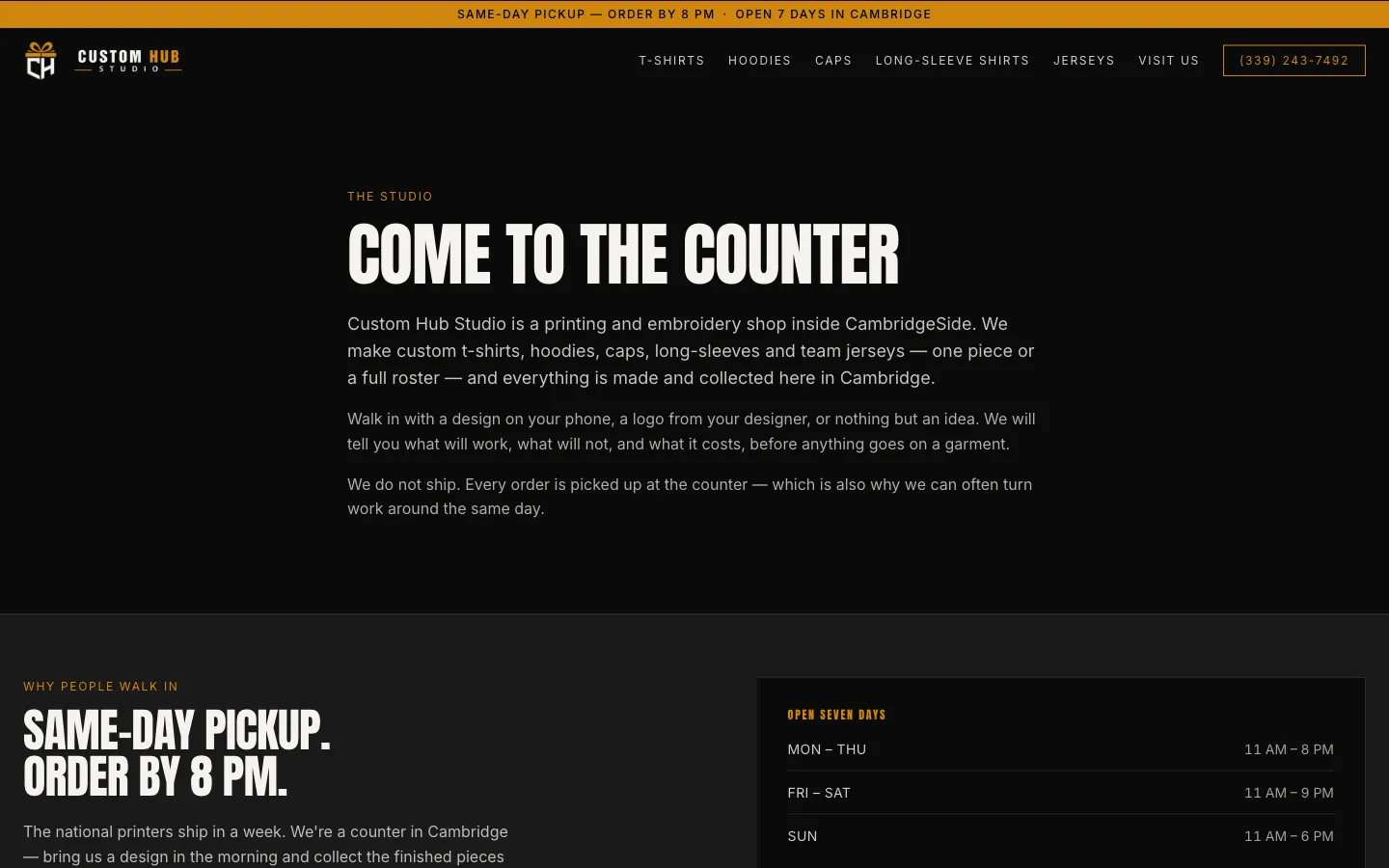
Custom Hub Studio is a custom printing and embroidery shop inside CambridgeSide mall in Cambridge, Massachusetts. They print and stitch t-shirts, hoodies, caps, long-sleeves and team jerseys to order, and every job is collected at the counter — same-day when the order lands before 8 PM.
They came to us with a shop, a logo, a phone number, and no website. We designed and built the whole thing: the brand site, the product photography, and the order flow that feeds the shop.
Challenge
- No product catalog to sell from. The shop doesn’t stock SKUs — it prints whatever the customer brings. A conventional ecommerce build would have been the wrong shape entirely.
- No photography, and no budget for a shoot. All the client had were phone snaps taken against a stockroom wall. Booking models, a studio and a photographer was out of reach.
- Competing against national printers. The big online printers ship in a week. The shop’s only real advantage — a counter in Cambridge and same-day turnaround — had to be the loudest thing on the page.
- Mall traffic is phone traffic. Most visitors arrive on a phone from local search, often on a weak signal. A heavy site would lose them before it painted.
Solution
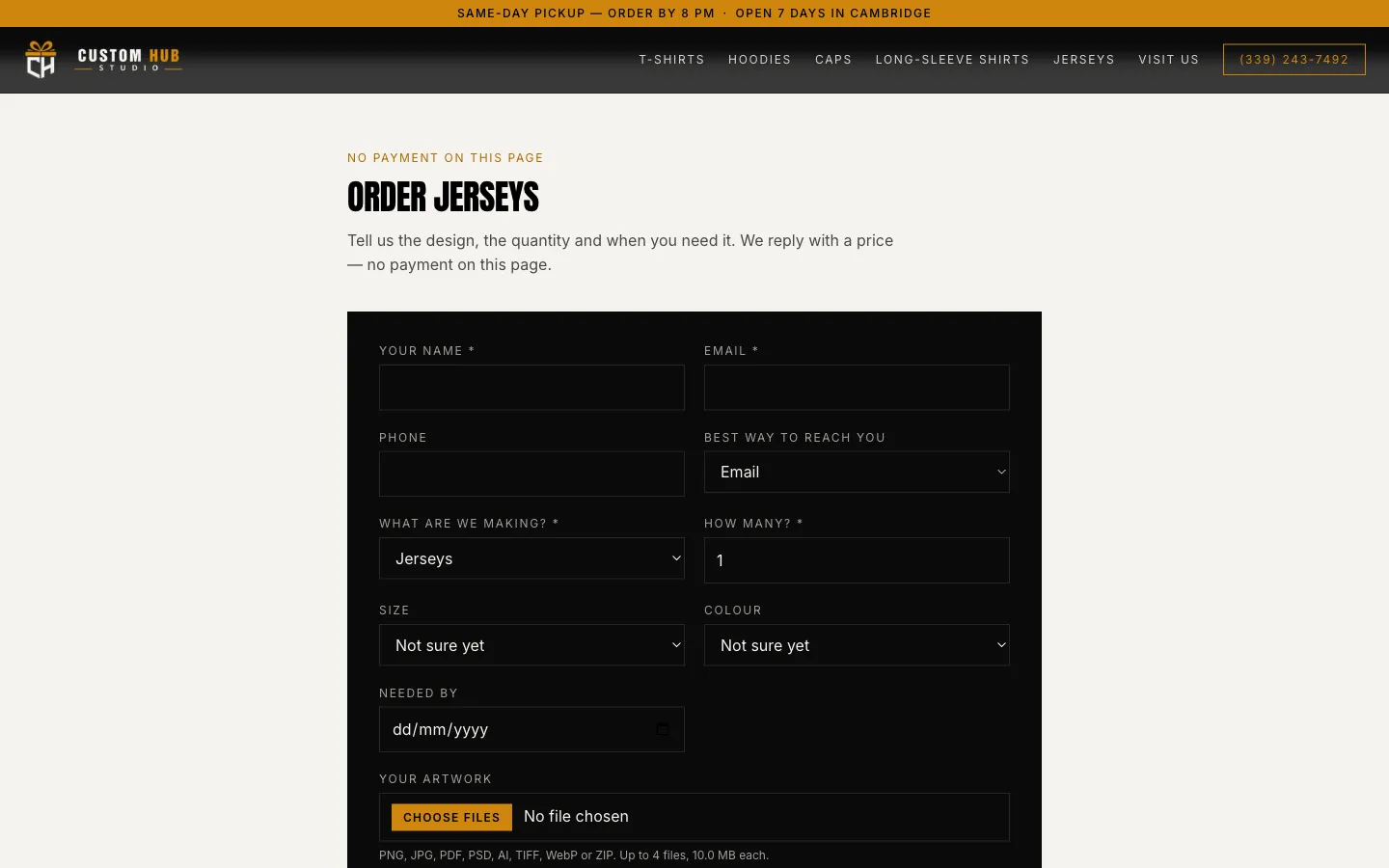
We built a brochure site with an inquiry flow instead of a store: no cart, no checkout, no accounts, no database. A visitor picks a garment category, attaches their artwork, and the order lands in the owner’s inbox, who quotes and confirms by reply. Every transaction still closes in the shop, which is exactly how this business works.
The content model reflects that. The unit of content is a garment category, not a product — seven Markdown files validated by a Zod schema at build time, so a typo fails the build instead of shipping a broken page. Adding a category means adding one file, never editing a component. Every business fact — address, phone, hours, slogan — lives in a single source file so the site, the JSON-LD and the Google Business Profile can never drift apart.
AI product photoshoot
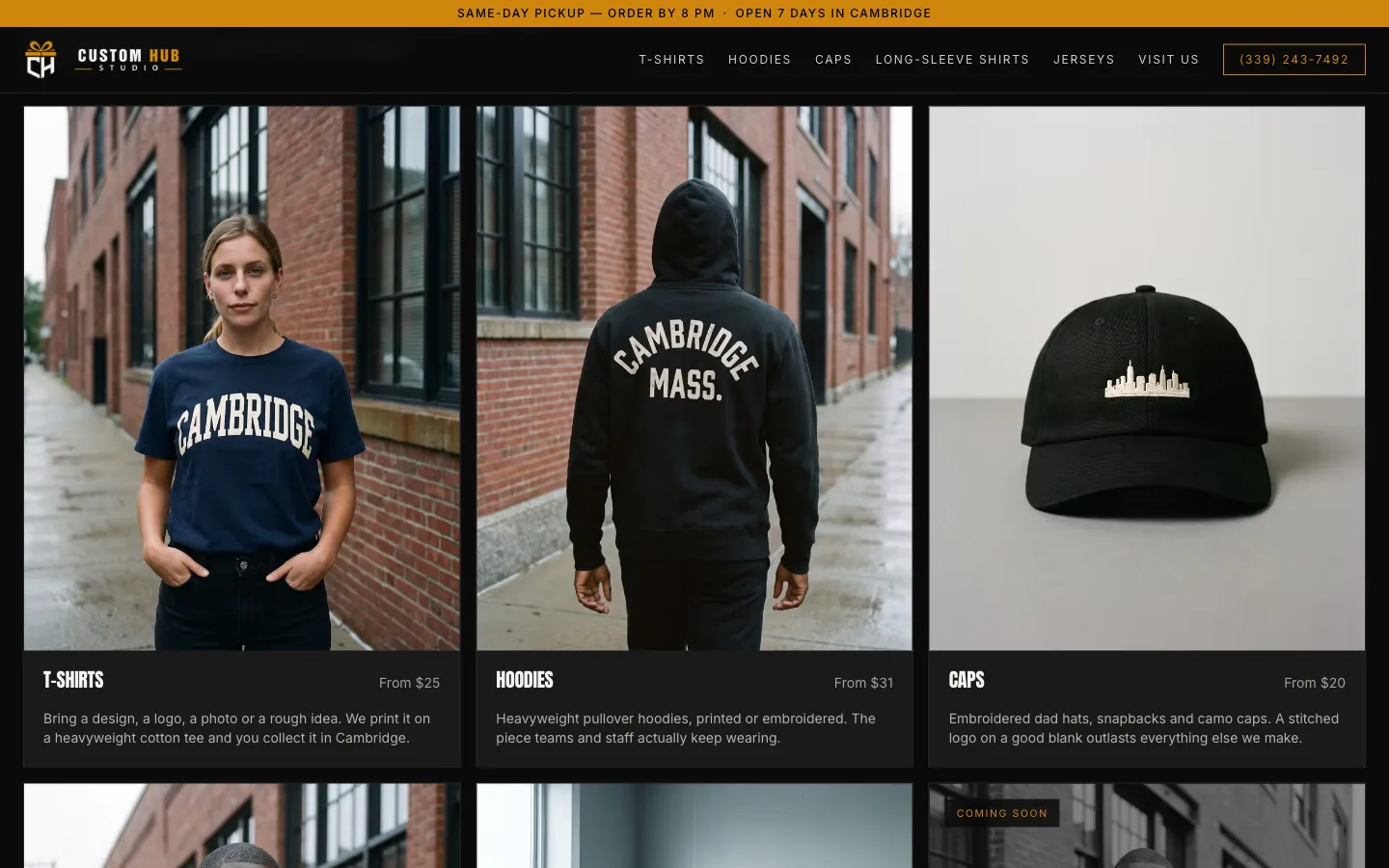
The client couldn’t fund a real photoshoot, so we produced one. We generated the entire catalog with a recurring cast of virtual models — three to four fictional people, each locked to a fixed reference so faces, builds and wardrobe stay identical across around 70 images.
- Consistency was the deliverable: one cast across every category is what makes separate listings read as a single brand rather than assorted stock photos.
- A fixed look — cool overcast daylight on New England brick, 50mm and 85mm framing, desaturated palette — so the garment always carries the only strong color in frame.
- Cast honestly for Cambridge: a university city, genuinely mixed in age and background.
- Strictly original artwork on every garment. No real likeness, no team marks, no third-party IP anywhere near production.
- The same pipeline produced the landing page imagery, a looping video on every category card, and a 20-second hero film shot entirely in generation.
We also rebuilt the brand assets programmatically, separating the client’s flattened JPEG logo back into its gold and ink layers and regenerating twenty clean transparent variants — mark, wordmark and lockups — for dark, light, single-colour and over-photography use.
Performance
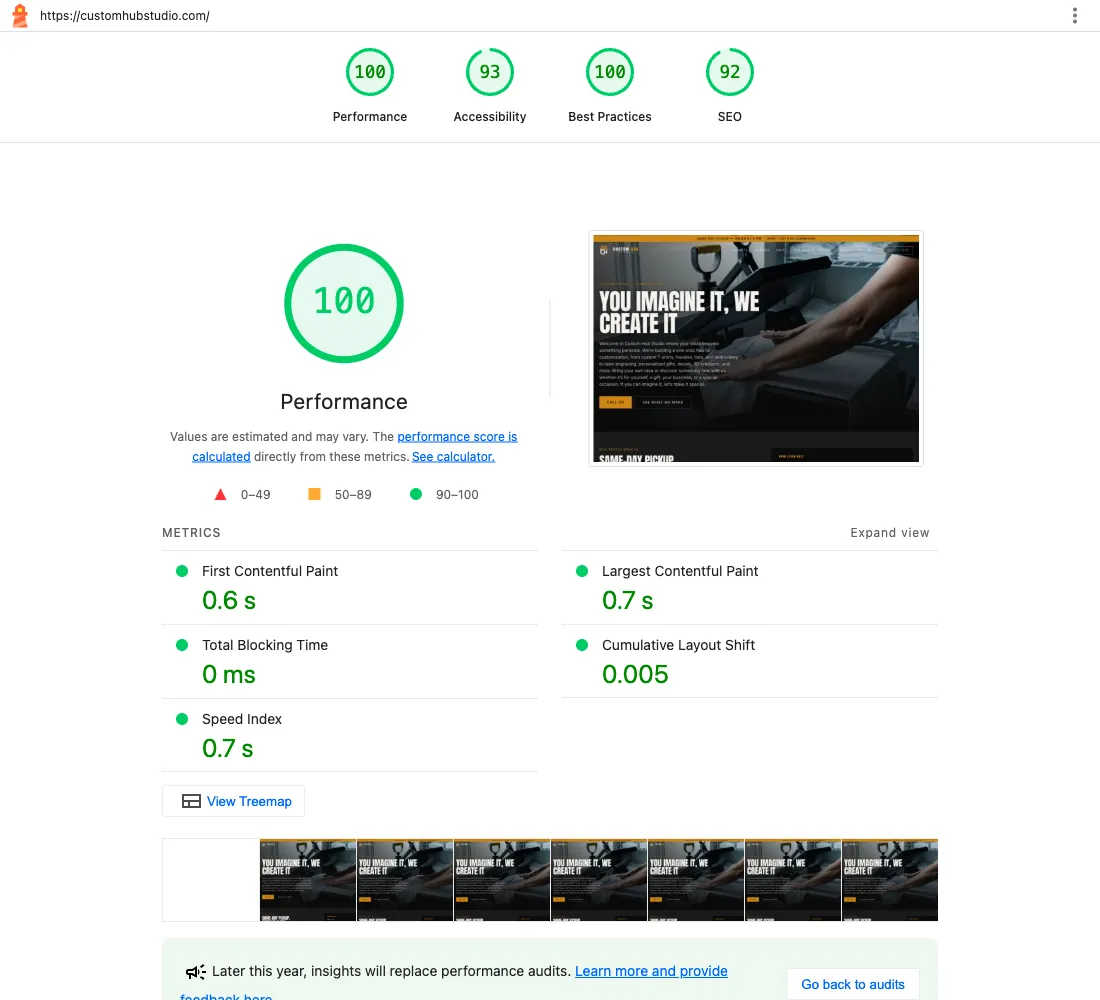
Speed was written into the contract, and the delivered site holds a Lighthouse performance score of 100 with 0 ms total blocking time and effectively zero layout shift.
- Zero client-side framework. No React, no component library, no icon package — the handful of SVGs the site needs are inlined.
- Every image goes through Astro’s asset pipeline to AVIF, encoded and committed ahead of the build rather than re-encoded on every deploy.
- Self-hosted variable fonts, preloaded, no third-party font request.
- One serverless function in the entire project: the order endpoint.
Key Features
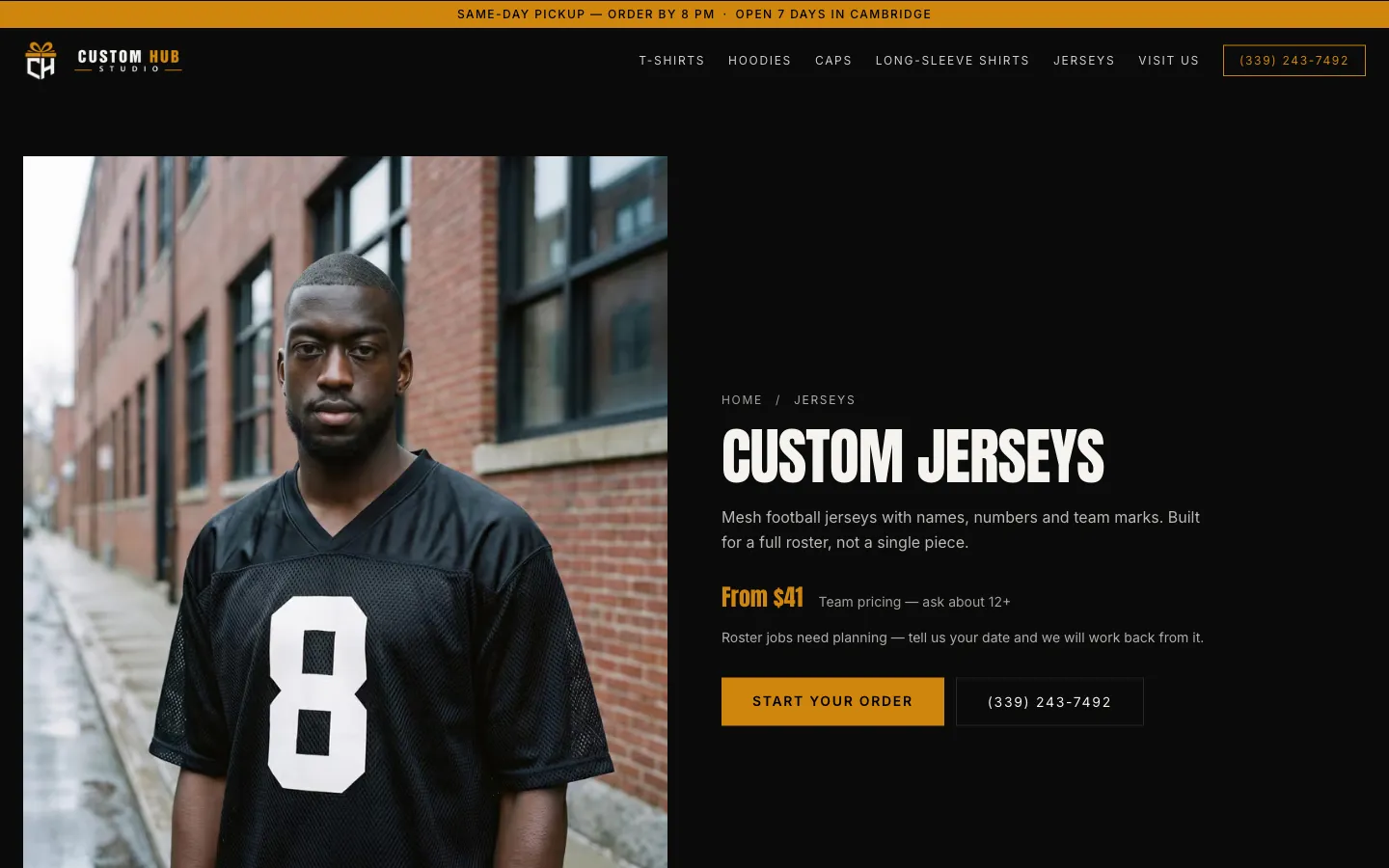
- Category pages with a design gallery, size charts, price ranges and an inline order form
- Artwork uploads — PNG, JPG, PDF, PSD, AI, TIFF, WebP or ZIP — stored on Vercel Blob and linked into the owner’s email
- Order emails through Resend, with a matching confirmation sent to the customer
- Anti-spam without a visible captcha for most visitors: Cloudflare Turnstile, a honeypot, a fill-time trap and per-IP rate limiting
ClothingStoreandProductstructured data, opening hours, service area and breadcrumbs for local search- Same-day pickup and opening hours surfaced on every page, driven from one config file
coming-sooncategories that render a badged card without generating a live URL
Results
- A shop that had no web presence at all now has a fast, fully indexable site with local structured data behind it
- A full, brand-consistent product catalog shot without a camera, a studio or a model fee
- Orders arrive with artwork attached and enough detail to quote from, instead of arriving as a phone call
- 100/100 performance on a site that is mostly photography — and it stays that way, because the budget is enforced in the build
Tech Stack
Astro 5 (static), Tailwind CSS 4, TypeScript, Zod content schemas, Vercel, Resend, Vercel Blob, Cloudflare Turnstile, sharp image pipeline
